


U.S. Tightens AI Chip Export Controls! New Challenges for Southeast Asian Data Center Investments and Global Technology Supply Chains
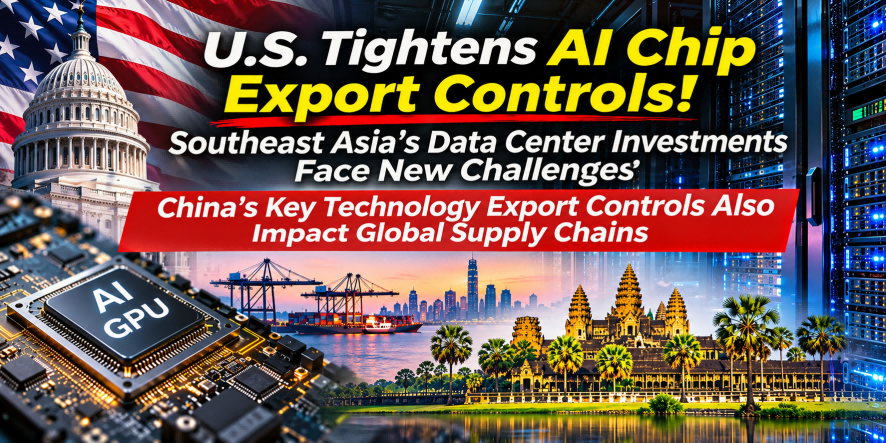
1. Global AI Competition Enters a New Phase: Chips, Computing Power and Export Controls Become Critical Investment Factors
Competition in the global artificial intelligence industry is expanding beyond model development, GPU performance and server manufacturing. It now increasingly involves semiconductor export licensing, data center end users, remote access to cloud computing resources and cross-border technology transfers.
On November 19, 2026, the U.S. Department of Commerce's Bureau of Industry and Security (BIS) published a new Interim Final Rule in the Federal Register entitled "Addressing Remote Access to Advanced Semiconductors."
The rule establishes new licensing and review requirements concerning the export, reexport and transfer within the United States of certain advanced semiconductors and related computing capabilities, as well as the use of remote computing resources by overseas data centers.
This policy development is particularly important to Southeast Asian investors because Singapore, Malaysia, Thailand and Indonesia have become significant destinations for global AI data center, GPU Cloud and server infrastructure investments.
The United States has included Indonesia, Malaysia, Singapore, Thailand and Brazil within the destination-based licensing requirements for certain advanced computing semiconductors.
The new rule took effect on November 19, 2026. The public comment period remains open until January 19, 2027.
This means that companies operating in Southeast Asia must pay closer attention to U.S. export control requirements when purchasing GPUs, developing data centers, providing cloud computing services and serving international customers.
Official Reference: U.S. Department of Commerce, Bureau of Industry and Security (BIS), Federal Register, Document No. 2026-23529.
2. Four Major Changes Under the New U.S. Export Control Rules
2.1 Singapore, Malaysia, Thailand and Indonesia Face Licensing Requirements for Certain AI Chips
The new U.S. rules include the following countries within the destination-based licensing requirements for specified advanced computing semiconductors:
-
Singapore
-
Malaysia
-
Thailand
-
Indonesia
Brazil is also included in the same category.
It is important to clarify that these measures do not prohibit all imports of GPUs, servers or semiconductor products into these countries.
Instead, they impose licensing requirements on specified advanced computing products and classifications under the U.S. Export Administration Regulations (EAR), covering applicable exports, reexports and transfers within the United States.
Certain transactions involving U.S.-headquartered companies and specific transactions involving entities whose ultimate parent companies are located in the United States may qualify for applicable license exception arrangements, subject to the relevant reporting requirements.
Companies should therefore not determine whether a product can be imported solely by looking at its commercial product name.
The following factors must also be examined:
-
Export Control Classification Number (ECCN).
-
Product performance and Total Processing Performance (TPP).
-
Identity of the exporter and reexporter.
-
Ultimate consignee and ultimate end user.
-
Ultimate parent company and actual control structure.
-
Whether the product will be resold, transferred through another jurisdiction or used for cross-border computing services.
Legal Implication:
Southeast Asian AI infrastructure projects can no longer rely solely on local company registration and import documentation as sufficient evidence of compliance. Investors must also determine whether applicable U.S. export control requirements apply to their transactions.
2.2 Overseas Data Centers Providing Computing Services to Certain China-Related Companies May Also Require U.S. Authorization
One of the most significant aspects of the new rule is the extension of regulatory scrutiny to remote computing capabilities provided by overseas data centers.
Under newly added EAR §744.24, certain transactions involving advanced computing equipment subject to U.S. export controls may trigger licensing requirements where the parties know that the equipment will be used for specified data center purposes and that the data center will directly or indirectly provide computing capacity above the prescribed threshold to companies headquartered in certain restricted destinations in China or Macau.
One important threshold is:
More than 12,000,000 Aggregate TPP.
This threshold may apply to a single data center or multiple data centers connected through a digital network.
This provision is particularly relevant to GPU Cloud providers and large-scale AI data center operators.
Example:
A company develops a data center in Malaysia and rents GPU computing resources to customers in different countries.
If a customer's ultimate parent company, actual control structure or actual use of the computing resources involves a restricted party, the fact that the physical servers are located in Malaysia does not automatically place the transaction outside the scope of U.S. export controls.
Regulatory scrutiny may also extend to arrangements in which computing services are provided indirectly to restricted companies through third-party customers.
The U.S. BIS requires relevant companies to conduct reasonable customer due diligence, including identifying direct and indirect ownership and control relationships.
It is important to understand that the regulation does not prohibit all Chinese companies from using data centers in Southeast Asia. Its application depends on the specified equipment, computing thresholds, end users and end uses.
2.3 Existing Data Centers Providing Relevant Computing Services Must Also Observe Transitional Deadlines
Data centers that were already providing substantial computing capacity to relevant restricted companies before the announcement of the new rule must also review their existing arrangements.
If they intend to continue providing the relevant services, they must obtain any required authorization within the 90-day period following the rule's effective date. Otherwise, they may face subsequent export restrictions.
Existing operators should therefore not assume that their previous server imports or local operating permits automatically protect their existing business arrangements.
Companies should reassess:
-
Export control classifications of existing GPU equipment.
-
Headquarters and ultimate parent companies of existing customers.
-
Actual users of computing resources.
-
Whether customers obtain computing services through affiliates or third parties.
-
Whether the services involve AI model training or other restricted uses.
-
Whether existing cloud service agreements need to be amended.
The U.S. regulations also provide exceptions for certain commercial recommendation systems. However, this exception should not be interpreted as meaning that all commercial AI services are exempt from the relevant restrictions.
2.4 The United States Restructures Its Global AI Chip Control Framework
The new rule also formally withdraws the implementation provisions of the previous Biden administration's AI Diffusion Rule.
BIS explains that the previous rule had not been implemented in practice and that the new Interim Final Rule formally implements the revised policy approach.
Companies should therefore base their transaction assessments on the new rules effective November 19, 2026, and the currently applicable provisions of the EAR, rather than relying on the withdrawn regulatory framework.
The above discussion is based on the rule published in the Federal Register on November 19, 2026.
3. China's Strategic Items Export Controls: Critical Materials and Supply Chain Policies Must Not Be Overlooked
While the United States is strengthening export controls on advanced computing semiconductors, China continues to administer certain critical materials, equipment and technologies through its strategic items export control framework.
However, companies must distinguish between the long-standing existence of China's export control system and specific recent policy adjustments. Not every measure should be described as a newly expanded restriction.
According to Announcement No. 58 of 2026, issued by China's Ministry of Commerce and General Administration of Customs on November 9, 2026:
The implementation of Announcements No. 55, 56, 57 and 58 of 2025, together with Ministry of Commerce Announcements No. 61 and 62 of 2025, will remain suspended from November 11, 2026, through January 10, 2027.
This is a policy adjustment with a defined period of application.
Companies must therefore determine the current status of the relevant requirements by examining the specific products and announcement numbers involved. The suspension of certain measures must not be interpreted as the complete removal of all Chinese strategic items export controls.
For the AI and semiconductor industries, the following supply chain areas require continued attention:
First: Rare Earths and Critical Minerals
Certain materials are relevant to high-performance magnetic materials, electronic equipment and advanced manufacturing supply chains.
Second: Gallium, Germanium and Related Materials
These materials may be relevant to semiconductor, optoelectronic and specialized electronic technology supply chains.
Third: Graphite and Battery Materials
Certain materials are used in energy storage, batteries and related industrial manufacturing.
Fourth: Semiconductor Manufacturing Equipment and Related Technologies
Cross-border procurement, technology licensing and equipment reexports must be assessed against the applicable control lists and licensing requirements.
Fifth: Critical Material Processing and Supply Chain Origin
Companies should not examine only the country from which the final shipment is exported. They should also assess the origin of raw materials, processing activities, export licensing requirements and contractual obligations.
For Southeast Asian investors, future investment assessments must consider more than GPU purchase prices. Chip availability, material sourcing, export licensing and supply chain stability are equally important.
4. Six Southeast Asian Markets: How Will AI Factory and Data Center Investments Be Affected?
The new U.S. rule does not impose identical restrictions on every Southeast Asian country.
A distinction must be made between countries directly included in the newly specified destination-based licensing requirements and countries that are not included in that list but may still be affected by other U.S. export control provisions.
4.1 Singapore: An Important Compliance Hub for Global GPU Cloud and AI Computing Transactions
Singapore has a mature international financial services, cloud computing and data center industry.
However, the inclusion of Singapore in the licensing requirements for specified advanced computing chips means that local GPU procurement, server integration, resale and cloud computing services require stronger compliance management.
Particular attention should be given to:
-
GPU imports and reexports.
-
Cloud computing customer screening.
-
End-user verification involving China-related companies.
-
Data center beneficial ownership and actual control.
-
Recordkeeping for server and GPU transactions.
Singapore-based companies must also consider their role as international trading and server distribution hubs.
If a company purchases servers in Singapore and subsequently transfers the equipment to another country, it must assess applicable reexport and end-use requirements.
4.2 Malaysia: Data Center Investment Growth and Semiconductor Supply Risks
Malaysia has become one of Southeast Asia's important data center investment markets.
The new U.S. rule may increase procurement, reexport and end-user verification costs for certain advanced GPUs and computing equipment.
For investors in Johor and other data center development areas, the following issues require further assessment:
-
Whether GPU supplies are legally authorized.
-
Whether data center customers comply with applicable export control requirements.
-
Whether electricity supply and long-term power arrangements are stable.
-
Whether foreign ownership structures and actual controlling parties are transparent.
-
Whether the data center can secure long-term, lawful and reliable computing customers.
Future Malaysian data center projects must comply with both local investment requirements and applicable international export control rules.
4.3 Thailand: AI Infrastructure Development Requires Stronger End-Use Verification
Thailand has an established foundation in electronics manufacturing, industrial parks and data center development.
However, licensing requirements for specified advanced computing chips will increase procurement and transaction review obligations for relevant projects.
Companies should pay particular attention to whether GPU equipment is intended for lawful commercial computing, industrial AI, cloud services or other specified uses.
Server integrators, equipment traders and data center operators should establish effective end-user verification and reexport management systems.
4.4 Indonesia: AI Investment Must Be Accompanied by Strategic Trade Compliance
Indonesia has a large domestic market, substantial energy resources and significant potential for data center development.
CNA reported on November 19, 2026, that the Indonesian government was assessing the impact of the new U.S. measures on its technology industry and data center investments and intended to conduct technical discussions with relevant parties.
Indonesian companies will need to consider not only local investment, import and customs requirements, but also the potential application of the U.S. EAR.
This development may also encourage Indonesia to further strengthen its strategic trade management framework and cross-border technology transaction procedures.
4.5 Vietnam: Not Included in the Newly Added Country List, but Not Completely Exempt
Vietnam is not included in the five newly added destination-based licensing jurisdictions under the U.S. measures discussed above.
However, this does not mean that all advanced GPUs, servers and related technologies can enter Vietnam without restrictions.
Where equipment is subject to U.S. export controls, or a transaction involves restricted end users, end uses or reexport arrangements, the relevant authorization may still be required.
Vietnamese AI Factory and electronics manufacturing companies must conduct case-by-case assessments based on product classification, transaction structure and ultimate end users.
4.6 Cambodia: An Opportunity to Develop AI Infrastructure, but Not a Transit Platform for Evading Export Controls
Cambodia is not included in the five countries newly added to the destination-based licensing list under the U.S. measures discussed above.
However, this does not mean that importing, installing or operating U.S.-origin GPU equipment in Cambodia automatically avoids U.S. export controls.
Particular attention should be given to:
-
Original export control classifications of GPUs and servers.
-
Legality of equipment imports and reexports.
-
Ultimate customers and ultimate parent companies.
-
Whether the data center provides remote computing capacity to restricted companies.
-
Whether third parties are used to purchase equipment or rent computing resources on behalf of restricted parties.
-
Whether the equipment is subject to other countries' export control or sanctions requirements.
If a company installs controlled GPU equipment in Cambodia but actually provides computing services to restricted overseas customers, applicable U.S. export control requirements may still be triggered.
CACC's Recommendation:
Cambodia AI Factory projects should be designed around lawful commercial customers, transparent ownership structures, clearly defined computing purposes and traceable equipment origins.
Cambodia should not be positioned as a transit platform for circumventing U.S. or other countries' export control requirements.
5. Taiwan's AI Server Supply Chain: Export Controls May Affect the Entire Industry
Taiwan plays an important role in global AI server manufacturing, including motherboards, thermal management systems, power supplies, racks and server assembly.
As U.S. export controls increasingly focus on the export, reexport and end use of advanced semiconductors, Taiwan-based supply chain companies must strengthen their compliance review procedures.
The following industries require particular attention:
| Industry | Key Compliance Considerations |
|---|---|
| GPUs and accelerator cards | ECCN classification, end users and export licensing |
| AI servers | Controlled components and reexport issues involving complete systems |
| HBM and high-performance memory | Product classification, suppliers and destination screening |
| Server motherboards | Product configuration, technical specifications and end use |
| Liquid cooling equipment | Equipment exports and project technical specifications |
| Power supplies and server racks | Customers, destinations and equipment integration |
| GPU Cloud | Computing service customers and ultimate users |
| System integrators | Resale, reexport and end-user declarations |
A particularly important point is that the new U.S. rule clarifies that certain advanced computing chips subject to the EAR may remain controlled even after being incorporated into foreign-produced GPU boards, servers or other equipment.
Therefore, companies cannot assume that a product is no longer subject to U.S. export controls simply because the server was assembled in Taiwan or the equipment was ultimately exported from a third country.
For Taiwanese server manufacturers and Southeast Asian purchasers, future transaction documentation must place greater emphasis on product classification, supply chain origin, end use and reexport responsibilities.
6. AI Factory and Data Center Investments: Three Essential Legal Reviews
For investors planning to develop AI Factories, GPU Cloud platforms or data centers in Southeast Asia, CACC recommends adopting a three-layer review framework.
First: Power-First – Electricity and Infrastructure Review
An AI data center cannot operate simply by purchasing GPUs and servers.
Investors must first confirm:
-
Land ownership and permitted land use.
-
Available electricity capacity and long-term power arrangements.
-
Electricity tariffs and power purchase agreements.
-
Backup power and energy security.
-
Liquid cooling and thermal management infrastructure.
-
Network connectivity and international telecommunications capacity.
-
Building permits, environmental approvals and fire safety requirements.
Without reliable electricity, even a project with GPU equipment cannot establish sustainable AI Factory operations.
Second: Operator-First – Identify the Operator and Business Model First
A data center project must establish who will be responsible for operating the facility.
Investors should identify:
-
Who manages daily data center operations?
-
Who procures GPU equipment?
-
Who markets and sells cloud computing capacity?
-
Who is responsible for cybersecurity?
-
Who conducts customer identity and compliance screening?
-
Who assumes responsibility for export controls and end-user compliance?
-
Who manages equipment maintenance and technology upgrades?
Without a clearly identified operator, investments in land and buildings may never translate into actual operating revenue.
Third: Bankability-First – Ensure the Project Is Financeable
Banks and institutional investors will not automatically provide financing simply because a project is described as an AI Factory.
They generally need to review:
-
Land ownership and title documentation.
-
Electricity supply and long-term power contracts.
-
Equipment procurement and lawful equipment origins.
-
The operator's creditworthiness and operating capabilities.
-
Anchor tenants and customer contracts.
-
Computing capacity sales and revenue models.
-
Export control and end-user compliance systems.
-
Project cash flow and debt repayment capacity.
CACC's Position:
The investment sequence for an AI Factory should involve simultaneous verification of electricity, operators, customers, equipment and financing conditions.
Investors should not commit substantial capital to GPU purchases first and only begin searching for customers afterward.
What Legal Services Can CACC International Law Firm Provide?
As technology trade policies in the United States, China and Southeast Asia continue to evolve, companies need more than ordinary company registration or general investment advice.
They need professional legal support for cross-border transactions, export controls and international compliance risks.
CACC International Law Firm / CACC ASEAN Legal Advisory Group can provide the following services, subject to the specific project and applicable jurisdiction.
1. AI and Semiconductor Export Control Legal Reviews
-
Export control reviews for GPUs and AI servers.
-
Analysis of the applicability of the U.S. EAR.
-
ECCN classification and export licensing coordination.
-
Reexport and end-use assessments.
2. Southeast Asian Data Center Legal Advisory
-
Cambodia and ASEAN data center investment structures.
-
Land and property title due diligence.
-
Electricity and infrastructure contracts.
-
Data center operator cooperation agreements.
-
International customer and computing service agreements.
3. Cross-Border Investment and Corporate Structuring
-
Company establishment in Cambodia.
-
International investment structure design.
-
Shareholding and actual control assessments.
-
Cross-border procurement and supply chain contracts.
-
Legal due diligence for investors and operators.
4. AI Governance and Corporate Compliance
-
AI Agent Governance Review.
-
AI Vendor Contract Review.
-
AI Data Privacy & Confidentiality.
-
AI Risk & Compliance Assessment.
-
Corporate AI internal governance policies.
5. ASEAN Legal Services and Cross-Border Transaction Coordination
Depending on the location of the project and the legal issues involved, CACC can coordinate qualified lawyers and professional institutions in the relevant jurisdictions to assist companies with cross-border investments, commercial contracts, regulatory reviews and dispute resolution.
Conclusion: The Future of Southeast Asian AI Investment Will Depend Not Only on Land and Electricity, but Also on Lawful Access to Computing Power
The global AI industry has entered a new competitive phase.
The United States is strengthening export controls on advanced semiconductors and overseas computing capabilities, while China continues to adjust its strategic items export management policies.
Although Southeast Asia offers advantages in land, electricity, markets and infrastructure development, the long-term success of its AI industry will increasingly depend on three essential conditions:
First: The ability to lawfully obtain advanced GPUs and servers.
Second: The ability to establish transparent and reliable operating structures that comply with international export control requirements.
Third: The ability to secure stable corporate customers, computing capacity orders and long-term financing.
For Cambodia, this presents both a challenge and an opportunity.
Cambodia does not need to become a transit platform for circumventing international export controls. Instead, it should develop AI infrastructure supported by transparent ownership structures, lawful equipment sources, reliable electricity, qualified operators and international commercial customers.
For Taiwan's server supply chain, international AI companies and Southeast Asian investors, this is an important time to reassess regional supply chains and investment structures.
CACC International Law Firm will continue monitoring technology-related legal and regulatory developments in the United States, China and ASEAN, assisting companies in evaluating legal risks involving AI infrastructure, cross-border investments, semiconductor supply chains and international commercial transactions.
If you are considering investing in an AI Factory, GPU Cloud, Data Center or Smart Logistics project in Cambodia, Singapore, Malaysia, Thailand, Indonesia or another ASEAN country, we recommend conducting legal and export control compliance reviews before purchasing land, procuring equipment or signing investment agreements.
CACC ASEAN – Your Cross-Border Legal Matters Start with the Right First Step.
About CACC
CACC ASEAN Legal, Investment & Business Solutions provides integrated professional advisory services in AI governance, cross-border investment, ASEAN market entry, AI data centers, GPU infrastructure, family offices and international legal compliance.
Our multidisciplinary team assists companies and investors in developing sustainable business strategies across Southeast Asia.
If you are an investor, Family Office, PE/VC fund, infrastructure fund or strategic investor interested in AI Data Centers, Power Infrastructure, BESS, Modular Power Infrastructure, GPU Infrastructure or other AI infrastructure investment opportunities being developed by CACC ASEAN, we welcome you to contact us.
Interested investors may contact the CACC advisory team directly through the Telegram, WhatsApp, Messenger or LINE icons on the right side of this webpage.
Cross-Border Legal, Investment, and Business Solutions
CACC also advises on legal and regulatory matters relating to ASEAN market entry, AI data centers, GPU computing infrastructure, power infrastructure, and battery energy storage projects, with an emphasis on lawful and transparent business structures.
Connect Through the Contact Icons on the Right
For legal or business advisory inquiries, click the Telegram, WhatsApp, Messenger, or LINE icon on the right-hand side of this page. Briefly describe the location, nature of the matter, and assistance requested.
 CACC ASEAN Legal Advisory Group
Legal • Investment • Business Solutions for the AI Era