


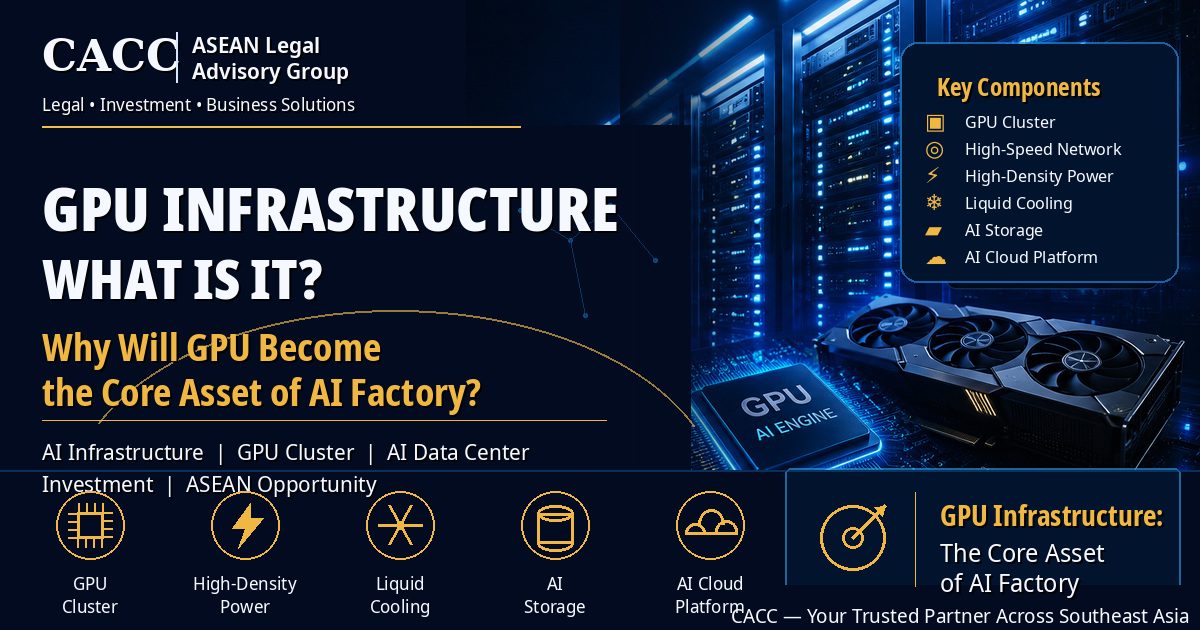
What Is GPU Infrastructure? Why Will GPU Become the Core Asset of an AI Factory?
The AI Era Has Moved from Software Competition to Compute Power Competition
Author: Johnny Ting. CACC ASEAN Legal Advisory Group.
Legal • Investment • Business Solutions for the AI Era
Over the past two decades, when companies discussed digital transformation, the focus was usually on software, ERP systems, cloud services, databases, websites and digital workflows.
For many businesses, digital transformation meant moving data to the cloud, adopting enterprise software, automating internal processes and building online service platforms.
However, with the rapid development of Generative AI, Large Language Models, AI Agents, robotics, autonomous systems, scientific computing and AI Factories, the foundation of corporate competition is changing.
In the future, the real competitive advantage of an enterprise will not only depend on how much data it owns or which AI model it uses.
The more important question will be:
Does the enterprise have sufficient, secure, stable and scalable GPU Infrastructure?
In simple terms, GPU Infrastructure will become the core production equipment of an AI Factory.
In the industrial era, factories needed production lines, power plants, railways, ports and warehouses.
In the AI era, companies that want to produce intelligence, model inference, tokens, AI services and automated decision-making capabilities will need powerful GPU Infrastructure.
GPU Infrastructure is no longer just an IT procurement issue.
It is becoming one of the most important foundational assets of the AI economy.
What Is GPU Infrastructure?
GPU Infrastructure is not simply the purchase of several GPU cards.
Many companies misunderstand this point. They believe that once they buy GPUs, they automatically have AI computing capability.
In reality, GPU Infrastructure is a complete AI computing ecosystem built around GPUs.
It usually includes:
- High-performance GPU clusters
- AI servers
- High-speed interconnect networks, such as NVLink, InfiniBand and Ethernet
- High-density power systems
- Liquid cooling systems
- High-speed AI storage
- AI Cloud Platform
- GPU resource management
- AI security
- AI governance
- Data management, access control and compute monitoring systems
A true GPU Infrastructure platform is the foundation that supports the long-term operation of an AI Factory.
It is not merely a collection of hardware.
It is an integrated system combining compute power, electricity, cooling, networking, storage, software, security and governance.
From an investment perspective, the value of GPU Infrastructure is not only measured by the number of GPUs purchased.
The more important question is whether these GPUs can operate reliably, be efficiently managed, scale over time and be converted into commercial AI service capacity.
Why Is GPU More Suitable for AI Than CPU?
Traditional enterprise systems mainly rely on CPUs.
CPUs are suitable for:
- ERP systems
- Financial systems
- Databases
- Website services
- General business applications
- Complex logic processing
A CPU is like a highly capable manager. It can handle complex tasks, but it is not designed to process massive numbers of repetitive calculations at the same time.
AI models are different.
AI training and inference require billions, tens of billions or even trillions of parallel calculations, especially in large language models, image generation, speech models, recommendation engines, robotics and scientific computing.
GPUs are built with massive parallel processing architecture. They can handle large-scale matrix operations at the same time, making them highly suitable for AI training and inference.
This is why most global AI infrastructure is built around GPUs rather than traditional CPUs.
In short:
CPU is suitable for traditional enterprise IT systems.
GPU is suitable for large-scale AI computing.
In an AI Factory, CPUs still matter.
But the real driver of AI computing capacity, model training speed and inference service scale is GPU Infrastructure.
GPU Infrastructure Is the Engine of an AI Factory
If we compare an AI Factory to a modern industrial factory:
- Land is the factory site.
- The Data Center is the building.
- Power is the energy system.
- Network connectivity is the transportation system.
- AI models are the production technology.
- Data is the raw material.
- The AI Cloud Platform is the operating system.
Then:
GPU Infrastructure is the engine of the entire AI Factory.
Without GPUs, even the most advanced AI models cannot run efficiently.
Without stable GPU Infrastructure, even the best AI business model cannot scale.
This is why more companies are beginning to treat GPU Infrastructure as a long-term strategic asset, not merely a one-time IT purchase.
In the past, companies invested in factories, machinery and production lines to manufacture physical products.
In the future, companies will invest in GPU Infrastructure to produce intelligence, AI services, automation capability and new sources of digital revenue.
This is one of the key differences between a traditional Data Center and an AI Factory.
Six Core Components of GPU Infrastructure
A commercially viable GPU Infrastructure project usually consists of six key components.
1. GPU Cluster
A modern AI Factory no longer depends on a single server.
Companies usually deploy hundreds, thousands or even tens of thousands of GPUs to form GPU clusters that can support large model training, model fine-tuning, inference services, AI Agent platforms and AI application development.
The scale of a GPU cluster directly affects the future AI service capability of an enterprise.
A stronger GPU cluster allows companies to:
- Train larger AI models
- Optimize models faster
- Serve more AI users
- Provide more stable inference services
- Reduce unit computing costs
- Build their own AI platform capability
In this sense, a GPU cluster is the core production line of an AI Factory.
2. High-Speed Interconnect
AI computing requires not only GPUs, but also fast data exchange between GPUs.
If the data transmission speed between GPUs is insufficient, even a large number of GPUs cannot deliver full performance.
Therefore, GPU Infrastructure must include high-speed interconnect networks, such as:
- NVLink
- InfiniBand
- 400G / 800G Ethernet
- High-speed fiber backbone networks
- Low-latency network architecture
The stronger the interconnect capability, the higher the efficiency of AI model training and the better the overall performance of the GPU cluster.
This is why an AI Factory is not just about buying GPUs.
It requires careful design of the entire network architecture.
For AI Infrastructure projects, poor network design can reduce GPU utilization, extend training time and weaken investment returns.
3. High-Density Power System
AI computing requires far more electricity than traditional data center workloads.
As GPU power consumption continues to increase, AI Factories must plan high-density power systems from the very beginning of the project.
This usually includes:
- High-voltage or medium-voltage power access
- Dual power feeds
- UPS systems
- Diesel generator backup
- Energy storage systems
- Intelligent energy management
- Power capacity expansion planning
- Grid stability assessment
In the future, power availability will become one of the most important conditions for AI project execution.
Many AI Data Center or AI Factory projects may be technically feasible, but the real bottleneck is often not the GPU itself.
It is power.
For investors, evaluating a GPU Infrastructure project should never be limited to the number of GPUs.
They must also review land conditions, power capacity, power stability, energy pricing and long-term expansion capability.
4. Liquid Cooling System
GPU computing generates significant heat.
As power density per rack continues to rise, traditional air cooling is gradually becoming insufficient for high-density AI computing.
As a result, next-generation GPU Infrastructure projects increasingly adopt liquid cooling technologies, including:
- Direct Liquid Cooling, DLC
- Immersion Cooling
- Hybrid Cooling
Liquid cooling is important because it can reduce energy consumption, improve equipment stability and extend the operating life of GPUs.
For an AI Factory, cooling capacity is operating capacity.
If the cooling system is insufficient, GPUs cannot run continuously at high performance.
This may lead to lower computing efficiency, hardware degradation, downtime risk and operating losses.
Liquid cooling has therefore become a core engineering issue in GPU Infrastructure projects.
5. High-Speed AI Storage
AI models need to read and process massive amounts of data.
If the storage system is too slow, GPUs will be forced to wait for data, reducing overall computing efficiency.
This is similar to a factory production line where the machines are ready, but the raw materials are delivered too slowly.
The entire production system becomes inefficient.
Therefore, high-speed AI storage is an essential part of GPU Infrastructure.
Companies usually need:
- NVMe storage
- Parallel file systems
- Object storage
- AI data lakes
- High-speed backup systems
- Data tiering and management systems
The goal of AI storage is to ensure that GPUs continuously receive data input and do not waste expensive computing resources due to slow data access.
From a business perspective, high-speed storage is not a secondary component.
It directly affects GPU utilization and overall investment returns.
6. AI Cloud Platform
Modern GPU Infrastructure is no longer limited to internal enterprise use.
More companies are adopting the GPU Cloud business model and providing AI computing services to external users.
In the future, GPU Infrastructure can become the foundation for:
- AI as a Service
- GPU as a Service
- Model training platforms
- Inference platforms
- AI Agent platforms
- Enterprise private AI platforms
- Industry-specific AI application marketplaces
This means GPU Infrastructure can become not only a cost center, but also a revenue-generating platform.
Through an AI Cloud Platform, companies can convert computing resources into commercial services for internal business units, ecosystem partners, developers, enterprise clients, financial institutions and even government users.
Therefore, the AI Cloud Platform is the key bridge that transforms GPU Infrastructure from a hardware investment into a business model.
Why Will GPU Infrastructure Become One of the Most Important Corporate Assets?
In the past, the most important assets of a company may have included:
- Land
- Factories
- Production equipment
- Brand
- Talent
- Customer resources
- Supply chain
In the future, companies will add another critical asset:
GPU Infrastructure.
Stable and scalable GPU computing capacity means that a company can:
- Train its own AI models
- Deploy AI applications faster
- Reduce long-term cloud computing costs
- Build AI service platforms
- Improve data security and technological independence
- Support internal automation
- Create new AI-driven business models
- Strengthen long-term competitive barriers
GPU is no longer just hardware.
It is becoming a key part of future enterprise competitiveness.
For large corporations, financial institutions, manufacturing groups, healthcare technology companies, logistics platforms, cloud service providers and government digital infrastructure projects, GPU Infrastructure may become one of the most important strategic investments of the next decade.
GPU Infrastructure Will Drive the Growth of the Entire AI Supply Chain
The development of GPU Infrastructure does not only create AI computing capacity.
It also drives the growth of an entire industrial ecosystem, including:
- AI servers
- High-speed switches
- Optical communication
- Liquid cooling equipment
- Power engineering
- Energy storage systems
- Intelligent energy management
- Data Center construction
- Cybersecurity
- AI Governance
- Cloud services
- Enterprise AI applications
- Cross-border data services
Therefore, the investment opportunity of the next decade will not come only from GPUs themselves.
It will also come from the complete ecosystem built around GPUs.
From GPUs to AI servers, from liquid cooling to power systems, from Data Centers to AI Cloud Platforms, and from AI Governance to cross-border compliance, the entire value chain will be upgraded by the development of AI Infrastructure.
This is why GPU Infrastructure is not only a technology trend.
It is a cross-sector investment opportunity involving law, finance, energy, real estate, data, cybersecurity, government policy and international business strategy.
ASEAN Is Becoming an Emerging Market for GPU Infrastructure
As global demand for AI Infrastructure continues to grow, Southeast Asia is becoming an increasingly important region for international investors.
ASEAN markets have several important advantages:
- Fast-growing digital economy
- Young demographic structure
- Increasing demand for enterprise AI transformation
- Rapid growth in e-commerce, fintech, logistics and manufacturing
- Continued expansion by international cloud service providers
- Government support for digital infrastructure
- Rising demand for Data Center and AI Infrastructure investment
Singapore, Malaysia, Thailand, Vietnam and Cambodia may each play different roles in the future AI Infrastructure value chain.
For international companies, ASEAN is not only a consumer market.
It may also become an important base for AI Factories, GPU Cloud, AI Data Centers and regional AI service platforms.
However, ASEAN is also a complex market.
Each country has different rules on land ownership, foreign investment, power policy, data compliance, taxation, government permits and investment structures.
Therefore, GPU Infrastructure projects in ASEAN cannot be planned from a purely technical perspective.
They must be designed together with local legal requirements, commercial strategy, government coordination and long-term investment structure.
CACC Insight
GPU Infrastructure is no longer only a technology investment topic for tech companies.
It is now a strategic issue for any enterprise that wants to adopt AI, build an AI Factory or invest in an AI Data Center.
As AI Infrastructure continues to expand, companies will face more cross-border legal and commercial challenges, including:
- Land acquisition and title due diligence
- AI Data Center investment structure
- Power and energy compliance
- Cross-border data transfer and privacy protection
- AI Governance framework
- Tax planning and corporate governance
- Foreign investment approvals and government permits
- International cooperation models
- Investment risk control
- Long-term operation and exit planning
For companies planning to enter ASEAN markets, GPU Infrastructure is not only a technology investment.
It is a comprehensive project involving law, investment, energy, data, government coordination and long-term commercial planning.
CACC is positioned to help enterprises integrate these cross-disciplinary requirements.
We provide one-stop legal, investment and business solutions for AI Data Center, AI Factory, GPU Infrastructure and cross-border investment projects.
Our role is to help clients move from project concept to execution, from legal structure to business model, and from investment risk assessment to long-term operation planning.
The goal is simple:
To help international investors build more resilient, compliant and competitive AI Infrastructure projects in Southeast Asia.
Free Initial Project Assessment
Whether you are planning an AI Factory, AI Data Center, GPU Infrastructure, cross-border investment, company formation, ASEAN market entry, Family Office or international legal compliance project, CACC ASEAN Legal • Investment • Business Solutions can provide a professional, practical and internationally oriented free initial assessment based on your project needs.
 ,WhatsApp
  , Messenger
  , or Line
  to connect directly with a CACC advisor.
✔ AI Data Center legal and investment advisory
✔ GPU Infrastructure project planning
✔ ASEAN market entry strategy
✔ Cross-border investment structure design
✔ Legal, business and long-term development planning
Legal • Investment • Business Solutions for the AI Era
Taipei │ Phnom Penh │ Singapore │ Kuala Lumpur │ Bangkok │ Ho Chi Minh City │ Dubai