


What Is AI Governance and Why Must Companies Establish an AI Management Framework Now?
What Is AI Governance and Why Must Companies Establish an AI Management Framework Now?
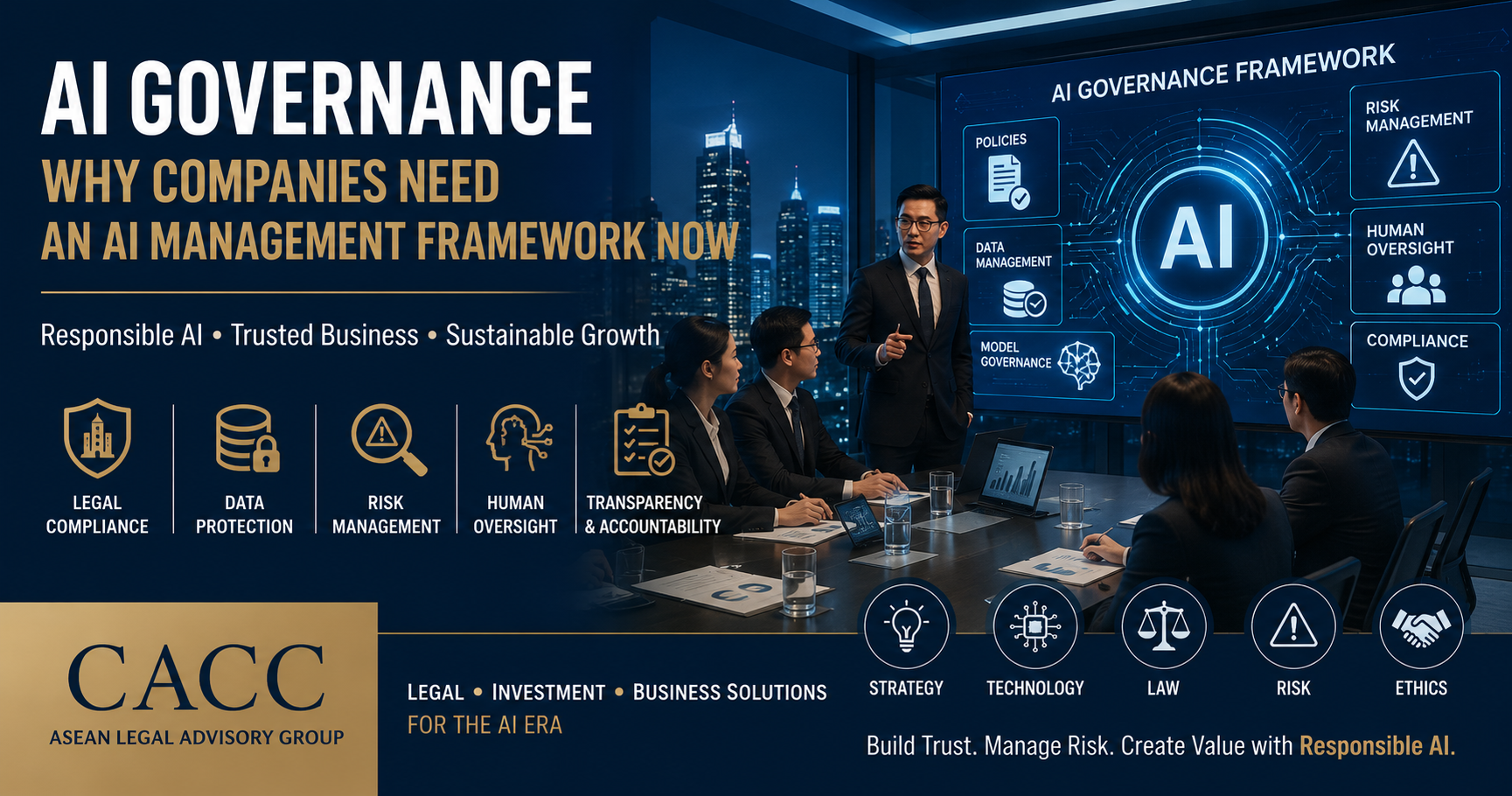
Author: CACC ASEAN Legal • Investment • Business Solutions
Legal • Investment • Business Solutions for the AI Era
Artificial intelligence is moving rapidly from an experimental tool into the core of business operations.
Companies increasingly use AI for customer service, data analysis, contract review, content generation, product development, recruitment, risk assessment, internal administration and strategic decision-making.
However, many organizations remain in a “use first, govern later” stage.
Employees may register for generative AI tools without approval, upload customer or corporate information to external platforms, rely on unverified AI-generated reports, or use AI outputs in important decisions without a clear review or accountability process.
This is why companies need AI Governance.
What Is AI Governance?
AI Governance is the framework of policies, responsibilities, controls and oversight mechanisms established by an organization to ensure that artificial intelligence is used lawfully, safely, transparently, responsibly and effectively.
AI governance is not a single policy document, and it is not merely an information technology issue.
A complete AI governance framework should address:
- Board and senior management oversight
- AI system and model management
- Data protection and confidentiality
- Legal and regulatory compliance
- Access rights and accountability
- Risk assessment and classification
- Human review and decision oversight
- Third-party and vendor management
- Incident response
- Employee education and training
- Documentation and audit records
In practical terms, AI governance should answer five questions:
- What AI systems is the company using?
- Who is authorized to use them?
- What information may be entered into them?
- Who reviews the output and remains accountable?
- What happens when the AI produces an error, causes harm or exposes confidential information?
Why Has AI Governance Become a Board-Level Issue?
Traditional corporate governance has focused on finance, taxation, internal controls, cybersecurity, human resources and legal compliance.
AI now participates in corporate decisions, customer communications, product development, employee management and market analysis.
AI risk is therefore no longer limited to the technology department.
It may directly affect:
- Corporate strategy
- Customer rights
- Confidential information
- Personal data
- Contractual liability
- Employment decisions
- Product safety
- Corporate reputation
- Director and senior management responsibility
When AI is used in recruitment, credit assessment, medical support, legal analysis, investment decisions or customer services, an incorrect output can result in real legal and commercial consequences.
Boards and senior management should therefore understand:
- Which AI systems the company is using
- Which uses are considered high risk
- Who approves and supervises those uses
- Whether appropriate records are retained
- Whether meaningful human review is available
- Whether an incident response process exists
AI Governance Is Not Intended to Stop Innovation
Some companies are concerned that AI governance will slow down innovation.
In reality, effective governance establishes safe boundaries within which AI can be used more confidently.
A practical AI governance framework should enable a company to achieve the following.
Lawful Use
The use of AI systems and data should be consistent with applicable laws, contracts and regulatory expectations.
Secure Operation
Employees should not upload customer data, trade secrets, source code, case documents or confidential corporate information to unauthorized AI platforms.
Traceable Decisions
For significant AI-assisted activities, companies should retain records of the system used, relevant data categories, output, reviewer and final decision.
Human Oversight
AI may support decision-making, but it should not automatically replace appropriate human judgment in significant legal, financial, employment, medical, investment or customer-rights matters.
Clear Accountability
A company should identify who uses, approves, supervises and makes final decisions involving AI. Responsibility cannot be avoided simply by stating that “the AI made the decision.”
What Risks Arise Without AI Governance?
Confidentiality and Data Leakage
Employees may enter customer records, contracts, financial data, source code or confidential project information into public AI platforms.
This may breach confidentiality obligations, customer contracts, employment rules, data protection requirements or trade secret controls.
Inaccurate Information and Poor Decisions
AI systems may generate inaccurate, outdated or fabricated content.
Using unverified AI output in contracts, legal analysis, financial forecasts, customer communications or investment decisions may expose the company to loss.
Intellectual Property Risk
AI-generated content may raise issues involving copyright, trademarks, licensing, employee-created work, training data and ownership of business content.
Bias and Unfair Treatment
AI used in recruitment, lending, insurance, pricing or customer classification may produce biased or unfair outcomes.
A company does not avoid responsibility merely because an automated system produced the result.
Vendor Risk
External AI providers may apply service terms, data practices, security controls, model updates and liability limitations that do not adequately protect the company.
Reputational Risk
An AI-generated error, discriminatory result, data leak or inappropriate customer response may quickly become a public reputational issue.
What AI Governance Policies Should a Company Establish?
At a minimum, companies should consider eight core mechanisms.
1. AI Acceptable Use Policy
The policy should define:
- Approved AI tools
- Uses requiring prior approval
- Information that must not be entered
- Outputs requiring human review
- Prohibited activities
- Consequences for non-compliance
The policy should apply to directors, management, employees, contractors and external advisers.
2. AI System Inventory
A company should maintain an inventory identifying:
- System or tool name
- Business department
- Intended purpose
- Data source
- Vendor
- Authorized users
- Risk classification
- Responsible reviewer
- Whether customer or personal data is involved
A company cannot govern AI systems it does not know it is using.
3. AI Risk Classification
Different AI uses should not be subject to identical controls.
A company may classify applications as:
- Low risk
- Medium risk
- High risk
The higher the risk, the stronger the approval, testing, documentation and human oversight requirements should be.
4. Data Governance
The company should determine:
- What information may be entered into AI systems
- When data must be anonymized
- What information must remain within internal systems
- How information is retained and deleted
- Whether a provider may use company data for model training
- How cross-border data transfers are managed
5. Model and Vendor Review
Before adopting an external AI service, the company should review:
- Provider background
- Contract terms
- Data retention practices
- Information security
- Model limitations
- Service availability
- Incident notification
- Liability limitations
- Data handling after termination
- Audit rights
6. Access Controls and Human Oversight
Not every employee should have the same AI access rights.
Permissions should be based on department, role, data sensitivity and intended use.
High-risk uses may require:
- Human review
- Dual approval
- Escalation procedures
- Appeal or correction mechanisms
7. AI Incident Response
The company should establish procedures for:
- Suspending the relevant system
- Preserving records
- Investigating the cause
- Assessing the scope of impact
- Escalating to management
- Notifying customers or authorities when appropriate
- Correcting inaccurate outcomes
- Assessing vendor responsibility
- Preventing recurrence
8. Employee Training
Policies without training are rarely effective.
Employees should understand:
- Which AI tools are approved
- What information must not be uploaded
- How to identify AI errors
- When human review is required
- What records should be retained
- Where incidents should be reported
Who Should Be Responsible for AI Governance?
AI governance should not be delegated entirely to one department.
A cross-functional governance team may include representatives from:
- Board or senior management
- Legal and compliance
- Information technology
- Cybersecurity
- Data management
- Human resources
- Risk management
- Business operations
- Internal audit
Larger organizations may establish an AI Governance Committee or appoint a Chief AI Officer, AI Risk Officer or Responsible AI Lead.
Smaller businesses may designate a senior manager supported by legal, technology and operational representatives.
Which Industries Particularly Need AI Governance?
AI governance is relevant to every organization using AI, but it is especially important in:
- Financial institutions
- Law firms and professional services
- Healthcare organizations
- Manufacturing
- Technology companies
- Government agencies
- Family offices
- Recruitment and human resources platforms
Why Do ASEAN Businesses Need a Common Governance Baseline?
ASEAN jurisdictions do not have identical legal, regulatory, data protection or industry frameworks.
A cross-border business should not build a completely separate AI governance system from the beginning in every jurisdiction.
A more practical approach is to:
- Establish a group-wide AI governance baseline;
- Adapt the framework to local laws and regulations;
- Classify risks according to industry and use case;
- Conduct specialized reviews for high-risk projects;
- Update policies and training regularly.
This “group standard plus local adaptation” model can reduce cross-border management costs while improving consistency.
Practical Steps for Implementing AI Governance
Stage 1: Identify
Map the AI tools, departments, data and use cases currently within the organization.
Stage 2: Classify
Identify low-, medium- and high-risk applications.
Stage 3: Establish Policies
Create acceptable-use rules, data controls, approval procedures and accountability structures.
Stage 4: Review Vendors
Assess AI providers, contracts, data handling and security controls.
Stage 5: Train Employees
Explain approved uses, prohibited activities and escalation procedures.
Stage 6: Monitor and Audit
Review AI use, incidents, model performance and policy compliance.
Stage 7: Update Continuously
AI technologies and legal expectations evolve rapidly. Governance frameworks should be reviewed and updated regularly.
CACC Perspective
The future of corporate competition will not be determined by AI capability alone.
It will also be determined by governance capability.
Companies may purchase similar AI tools, but they will not necessarily have the same policies, data quality, controls, accountability or implementation discipline.
Organizations with effective AI Governance will be better positioned to:
- Build customer confidence
- Pass partner and investor reviews
- Reduce legal exposure
- Protect trade secrets
- Improve internal efficiency
- Support cross-border growth
- Strengthen long-term brand value
AI governance should not be treated as an administrative task to be addressed after digital transformation. It should be part of the foundation on which enterprise AI adoption is built.
Discuss Your AI Governance Framework with CACC
Is your company using generative AI, AI agents, automated decision systems or third-party AI platforms?
CACC can assist with:
- AI use assessments
- AI legal and compliance risk reviews
- AI governance framework design
- Corporate AI acceptable-use policies
- Data and confidentiality controls
- AI vendor contract reviews
- High-risk AI project assessments
- Board and employee AI compliance training
- Cross-border ASEAN AI compliance planning
Connect with CACC www.cacclaw.com through WhatsApp, Telegram, LINE, Messenger or WeChat using the contact icons on this page.
Please briefly provide:
Company jurisdiction|Industry|AI tools currently used|Relevant data types|Key issues requiring assistance
Our team will conduct an initial review and recommend the appropriate next step.
Contact CACC today to establish a clear, practical and sustainable AI governance framework.
Notice
Submitting an enquiry does not by itself establish an attorney-client relationship. Please do not send highly sensitive or confidential documents before CACC completes its conflict check and formally accepts the engagement.
CACC ASEAN Legal Advisory Group
Legal • Investment • Business Solutions for the AI Era
Official Website: www.cacclaw.com